BSC Annual Meetings
Biological Stain Commission Annual Meeting
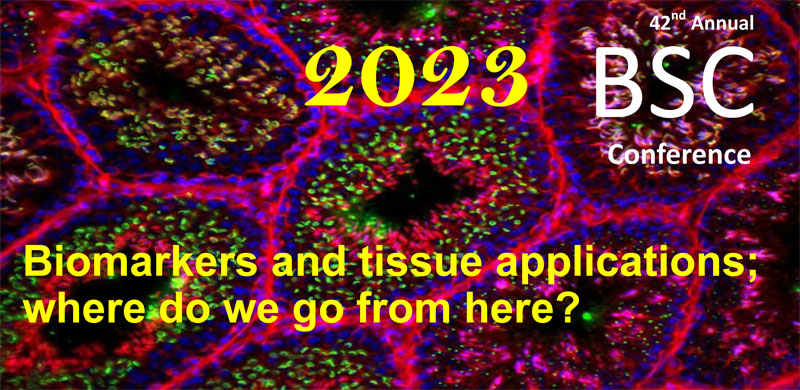
2023 Biological Stain Commission Annual Meeting
June 9th, 2023
REGISTRATION:
January 9th, 2023—May 15th, 2023
ABSTRACT SUBMISSION DEADLINES:
Oral Presentations: May 9, 2023
Poster Presentations: May 9, 2023
The One Day Symposium will be
held @ Sarah Flaum Atrium
ADDRESS:
Room G-9500
415 Elmwood Avenue
Rochester, NY 14642
The Annual Meeting includes a symposium with invited speakers, a business meeting with reports from the Commission’s officers and committees, presentations by members, and informal discussions and question and answer sessions on scientific and technical topics. Participants include users, manufacturers and vendors of stains, experts in dye analysis and testing, and other interested parties, such as representatives of scientific societies, the FDA and the ISO.
These Scientific Meetings usually are held in early June, often in or near Rochester NY, the site of the Commission’s testing laboratory, and also in other major North American cities.
OTHER RELEVANT MEETINGS: Watch this space! To submit a notice about a meeting, contact the BSC’s webmaster.
To review the proceedings of recent BSC meetings (since 1995), Click here.
Annual Meeting Archives
Annual meeting 2019 – Rochester, NY
The 2019 annual meeting of the Biological Stain Commission was on Friday and Saturday 14th and 15th June 2019, at the University of Rochester Medical Center (URMC), near the Hilton Garden Inn, 30 Celebration Drive, Rochester, New York, 14620, USA. The theme was “The...
Saratoga Springs, NY, March 2018
The BSC's annual meeting for 2018 was held on 16th and 17th March, jointly with the New York State Histotechnological Society (NYSHS), at the Holiday Inn Saratoga Springs, NY. The schedule was: Friday March 16. BSC Membership, Business and Committee Meetings....
2017 – Pittsford, NY
The 2017 meeting was held on 1st to 3rd June 2017 in Pittsford, which is near Rochester, NY, at the Del Monte Renaissance Hotel, Pittsford, NY. Themes for the scientific sessions on Friday 2nd June were “Fluorochromes” and “Autophagy and use of new techniques that can...
Have you paid your membership?
Have you paid your membership? Membership is ordinarily renewable one year after the last payment of dues. Each member should receive an automatically generated email reminder, three weeks before the renewal date. Many graduate students and other clinical and...
Annual meeting June 2017 in Pittsford, NY
The 2017 meeting was held on 1st to 3rd June 2017 in Pittsford, which is near Rochester, NY, at the Del Monte Renaissance Hotel, Pittsford, NY. Themes for the scientific sessions on Friday 2nd June were "Fluorochromes" and "Autophagy and use of new techniques that can...
Download PDFs from June 2016
Download PDF files based on presentations given at the joint meeting of the Biological Stain Commission and Michigan Society of Histotechnologists, 3rd-4th June 2016 R. W. Dapson Schiff's Rainbow - The mechanisms and consequences of multi-colored Schiff reagents - ...
Annual Meeting 2016 in Grand Rapids, Michigan
BIOLOGICAL STAIN COMMISSION The annual scientific meeting for 2016 was held jointly with the Michigan Society of Histotechnologists. Theme: AN EVENT TO DYE FOR! June 3rd - 4th 2016, Grand Rapids Double Tree Hotel, Grand Rapids, Michigan, USA. Program. PDF files...
Annual Meeting 2015
___________________________________________________ There was no scientific meeting in 2015. The trustees met in Pittsford, NY on Friday 5th June 2015 for a facilitated discussion: Design for the future: Development of the next 5-year plan for the BSC. The Annual...
2014 – Washington, DC
View the PDF file here.
2013 – Washington, DC
View the PDF file here.